
Spring turkey hunting is almost always a one-shot proposition. Not many gobblers are going to wait around for you to take a second shot. Most hunters know this, yet there are a large number of turkey hunters who never shoot their shotguns to check the pattern. Or perhaps they shoot at a head-neck gobbler target and — when they find that just a couple of pellets hit the fleshy part of the — they think that will do. Not so!
A gobbler is one tough bird. It takes a solid hit in the nervous system to put him down on the spot. That means one or hopefully many more pellets must hit the brain and/or spinal column with enough energy to destroy it. For this reason hunters should spend time on the range shooting at turkey targets with a shotgun and choke tube. The goal of this range time is to find a specific load that will consistently place a dense pellet pattern within the nervous system of a turkey.
It comes as a surprise to many hunters that every time one changes a choke tube, or shotshell load, or size of pellets or sighting system, the odds are great that the pattern might change. It might throw a pattern off-center or make a hole in it that a gobbler could walk through unharmed. You can never predict the change. Only time spent shooting at turkey targets on the range will show if the combination is throwing a killing pattern or not.
Use The Right Targets
To repeat, any time you make a change to a target-shooting system, you need to shoot several times at a turkey target to evaluate the pattern. Something as simple as going from #4 shot to #5 shot might change a pattern’s effectiveness. I like to start my pattern test using a Red Star turkey target.
It is a full-size target, with a 30-inch ring around a life-size gobbler head-neck in the center. The head-neck shows the brain and spinal column, the vital part of the target, and where you want to see multiple hits. At 40 yards, with one shot fired from a solid rest, this target will show you if the pattern is centered at the point of aim. You also can determine the pattern density on the nervous system.
If the pattern is centered, but there needs to be some further sight adjustments, go to the smaller head-neck targets that show the spine and brain. I like the Shoot-N-C targets that are made by Birchwood Casey and the targets offered by Caldwell, H.S. Strut and Champion Targets. These targets, readily available where turkey-hunting products are sold, will tell you quickly if the pattern is missing the vital nervous system and only placing pellets in the fleshy parts of the head and neck.
Shoot From the Distances You Shoot in the Woods
Using targets, shoot from 20, 30 and 40 yards. If you’re likely to have a shot that’s farther, shoot at those supposed distances. Study each target carefully and watch for pattern point-of-center change, holes developing in the pattern, or the pattern suddenly opening up with few pellets hitting vitals.
Making Corrections
If the center of the pattern mass is off, the solution is usually easy: adjust the sights. If you’re shooting a shotgun that has no sighting system, consider getting a sighting system such as a shotgun scope to use to adjust the centering of the pattern mass. Rifle-type sights on a turkey gun can be an advantage for tight-shooting patterns and adjusting center mass.
If holes are in your pattern, then you might try a different choke tube or shotshell brand, or change the shot size. Any and all of these changes might correct holes developing in patterns. At best, it is trial-and-error, which requires a lot of shooting; but with patience you can solve the problem.
As you are trying different combinations, save the used targets. On the back, record the shotgun, choke tube, brand of shotshell, load data and shot size used. As you evaluate each combination, refer back to the targets for compared results.
Turkey shotguns can be fickle. However, as firearm and ammo manufacturers have improved their turkey-hunting products, spending hours on the range trying to get a turkey-killing pattern is not as difficult as it once was. We are still not to the point where a pattern session on the range is not necessary, however. It is necessary and can mean the difference between success or failure when that one-shot opportunity presents itself on a spring morning.
BONUS: Patterning Made Easy With Computerized Patterning Board
In preparation for a spring turkey season, I sent my Remington 11-87 Special Purpose chambered in 3-inch 12 gauge to Rob Robert’s Custom Gun Works in Batesville, Arkansas. I wanted to find the perfect shot size and choke combination for my turkey gun.
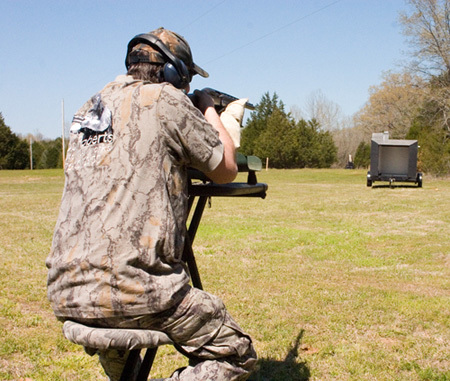
Robert utilizes a computerized patterning board. The system records the pattern with a digital image and then transmits the file to a computer where a software system analyses the data. The numbers are broken down into useable information, such as total pellet count in the shell; number of pellets inside a 30-, 20- and 10-inch circle; point of impact in relation to aim point, and a crystal-clear image of the pattern distribution. The system also reveals a percentage for the choke used, so after several different choke/shot sizes are fired you can simply look at the percentage to tell which combo places more pellets in the pattern.
The procedure is simple and pain free. The computerized pattern analysis cost $150 (easily the price of several premium boxes of turkey shells). You send a brief letter with your gun describing your preferred shot size (#4, #6, etc.) and the type of hunting you want to do. If you own several chokes, they'll pattern more than one choke for an additional $50 each.
They will shoot your preferred shot size in all different brands — as well as with various choke combinations if requested — until they find the one that your gun shoots best. Robert’s will also fire your gun with their custom chokes. If their choke outperforms the others, they will call and let you know the results so you can choose to purchase or not. If one of your chokes outperforms the others, they will send you back the gun with pattern printouts and a written letter explaining which combination worked best.
It turned out my gun liked Winchester 3-inch Xtended Range #6s, with a Rob Robert’s Custom Choke of .655-inch constriction. To give you an idea of what this choke did: My factory Remington choke (the same one I’ve killed more than 25 gobblers with over the years), along with the same Winchester load, would put 73 pellets in a 10-inch circle. By replacing that choke with Robert’s choke and shooting the same Winchester load, my pellet count more than doubled in a 10-inch circle to 164 pellets. Both choke/shell combinations were shot from 40 yards.
To learn more about Robert’s pattern analysis system and their custom gun work, visit Rob Robert''s Custom Gun Works; or call (870) 251-9955.
— Mark Olis