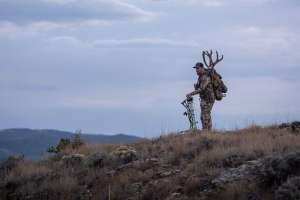

If you know me, you know I’m obsessed with Coues whitetail hunting. There is NOT another big game species I would rather pursue.
I’m sure the mere mention of the Coues whitetail likely conjures up a cactus-filled desert setting, and perhaps, a hunter situated behind a bolt-action rifle capable of making shots at great distances. However, the Coues whitetail is a hearty animal that resides across diverse habitats. One lesser-known habitat is the pine and mixed-conifer forest, situated at 7,000-plus feet above sea level. This Coues-niche is ideal to hunt Coues deer — from a treestand, bow in hand.
Coues Composite
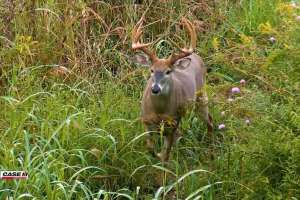
Locating and monitoring Coues deer whereabouts can be feudal, especially in the terrain above the Rim. Although they are not mandatory, the trail camera is a valuable tool to search out Coues deer there. That said, my use of trail cameras is just as much for the enjoyment of perusing the images it captures, as it is a tool for hunting.
One year, during the fall OTC deer season in Arizona, one of my cameras captured an image of a giant Coues buck. For the next several years, I hunted that buck exclusively — sort of. The image provided with this column, which I call “Coues Composite,” details my pursuit of the giant buck.
If you look closely in the upper left-hand corner of the image, you will notice me in my treestand. While it appears that I am casually looking over a bachelor group of Coues bucks, it’s actually a composite of several images “Photoshopped” together. The images are real, taken at random times, by one camera.
In the bottom-right of the image are two up-and-comer bucks. Both of these bucks would score well over the P&Y minimum; still, they’re young deer. One year during my pursuit, I had these two bucks and another 100-plus-inch buck at 25 yards but elected to pass. My decision was simple: I was waiting for the buck pictured on the left, covered partially behind the ponderosa pine.

This camera setup captured images of this giant buck for 5 years. The first year, the buck had less mass, but several more tines and non-typical points. Another year, the buck grew a second main beam on its right side; the mass of both antlers was incredible. The year after, the buck put on an enormous amount of mass once again. On the year this image was captured, the buck was already past his prime and digressing, unfortunately. Perhaps just as unfortunate, this image was the last I captured of the giant Coues buck.
Oh yes, what about the buck in the middle? This buck was the giant buck’s everyday companion — except for one. While on stand, I watched this buck, one I called the “G2 Buck” because of a small kicker on its G2 tine, approach my stand. I waited anxiously for the bigger buck to arrive, but it never happened. Finally, I convinced myself the G2 Buck was worthy of an arrow. I drew, fired and killed the 108-inch gross-scoring velvet buck. The buck was my best Coues trophy; still a far cry from the buck-that-got-away.
While I am capable of inking a few thoughts regarding my Coues hunting passion, others are purely inexplicable. My obsession — integral to my soul — burns deep within my core. I understand that it may not be for the Coues whitetail, but I hope you too have a bowhunting passion that burns deep within your core. If so, keep it lit!
If you would like to know more about hunting Coues above The Rim or would like to share your experiences with me, please send me a note. If there is a topic you would like to see highlighted or expanded upon in the pages of Bowhunting World, please do not hesitate to send me an email (darren.choate@grandviewoutdoors.com) with your thoughts. Best to you!